

Speed Mingle News
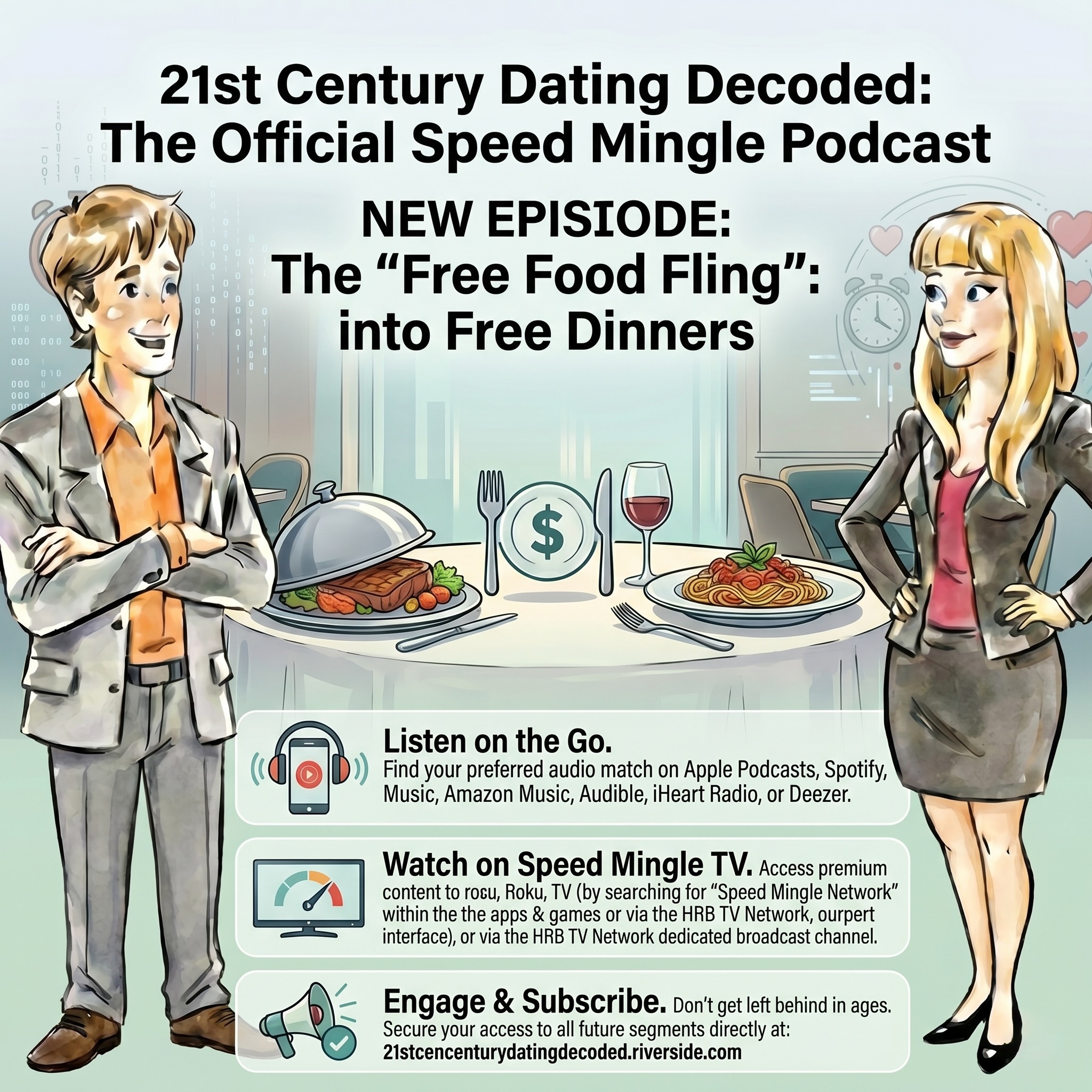
The ‘Free Food Fling’: Turning First Dates into Free Dinners
Published on Saturday, June 6, 2026
A compounding convergence of escalating living costs, systemic inflationary pressures, and protracted wage stagnation has catalyzed an unconventional, highly transactional strategy within the contemporary dating ecosystem: the conversion of initial romantic encounters into multi-day nutritional subsidies. This phenomenon reflects a broader behavioral shift where individuals leverage the social conventions of courtship to secure immediate consumer goods. As structural economic pressures intensify, a critical question emerges: Is the conventional, dinner-based first date facing systemic obsolescence?
Consider the behavior of a twenty-six-year-old marketing coordinator navigating contemporary dating applications. Her engagement with these platforms extends far beyond an assessment of interpersonal chemistry, alignment of values, or intellectual compatibility. Instead, she executes a calculated cost-benefit analysis of the proposed venue. By auditing online menus, cross-referencing price points, and evaluating the caloric density of specific culinary options, her approach mirrors asset evaluation rather than romantic anticipation.
This individual belongs to an expanding, highly pragmatic demographic participating in a socioeconomic trend termed the “Free Food Fling” (or colloquially, the “Foodie Call”). The operational framework of this strategy is highly methodical: secure an invitation to a premium dining establishment, engineer the ordering of excessive provisions under the rhetorical guise of “communal dining,” and systematically secure the surplus via premium packaging at the conclusion of the encounter.
The Macroeconomics of Contemporary Romance
“In the current economic climate, this functions fundamentally as a mechanism for resource optimization,” notes one practitioner, while organizing multiple vacuum-sealed containers of artisanal pasta, roasted root vegetables, and premium proteins within her refrigerator.
“With localized residential rents appreciating by 40%, grocery inflation reaching unprecedented thresholds, and dating platform dynamics producing a surplus of counterparts willing to fully subsidize encounters to guarantee attendance, this behavior represents the exploitation of a distinct market inefficiency. I am optimizing my return on investment. A singular, high-value dining engagement at a premium establishment effectively covers my nutritional overhead for multiple subsequent days.”
What was historically categorized as a severe breach of social etiquette—an opportunistic exploitation of a suitor for material gain—has been institutionalized, optimized, and disseminated across global digital networks. On micro-video platforms such as TikTok and Instagram, content tagged under #FreeFoodFling and #FoodieCall routinely accumulates hundreds of millions of impressions. These digital dispatches feature creators documenting their culinary acquisitions, supplemented by granular, step-by-step tutorials detailing how to direct table conversations to maximize order volume without triggering defensive behaviors from their counterparts.
The phenomenon of the “Free Food Fling” operates as a highly visible digital media signal, characterized by exceptional engagement metrics across social platforms under viral hashtags like #FoodieCall. This digital footprint does not merely reflect a passing trend; rather, it exposes a deeper generational polarization regarding modern romance and economic survival. Within this landscape, two distinct behavioral archetypes emerge. On one side, Group A approaches the phenomenon through the lens of categorical financial opportunism, viewing romantic interactions purely as strategic transactions to secure premium goods and services without personal cost. Conversely, Group B frames these actions as a form of rationalized wealth redistribution. For this cohort, leveraging the traditional expectations of dating culture is seen as a justifiable mechanism to offset systemic economic pressures, balancing the financial scales against a wealthier demographic or a punishing cost of living.
The public discourse surrounding these publications reveals a deep generational and socioeconomic divide. Detractors categorize the practice as unambiguous financial opportunism and a breach of implied interpersonal contracts. Conversely, proponents frame it as a rationalized, Robin Hood-style redistribution of capital operating within a structurally flawed economic landscape.
The Operational Mechanics of the Fling
Practitioners suggest that executing this strategy requires a sophisticated synthesis of social engineering, applied psychology, and menu manipulation. The objective is to maximize the aggregate volume and preservation utility of the bill, while maintaining sufficient interpersonal engagement and apparent romantic interest to prevent the counterpart from demanding a structural division of the expenses upon check presentation.
Phase I: The Bait: The practitioner strategically guides the venue selection toward premium establishments known for extensive, high-value small plates and shareable side dishes. This establishes a structural foundation that decentralizes the meal away from individualized entrees, normalizing a high-volume, multi-dish spread.
Phase II: The Build-Up: Upon seating, the practitioner asserts control over the ordering narrative, enthusiastically insisting on selecting items “for the table.” By framing the dinner as a collaborative epicurean exploration, the counterpart’s financial defense mechanisms are neutralized, facilitating a lavish, uncapped ordering sequence.
Phase III: The Climax: The ordering trajectory is deliberately steered toward dense, calorically stable, and easily reheated dishes—such as rich braised meats, heavy starches, or complex stews. These specific profiles are selected because they retain structural integrity and flavor profile stability during refrigerated storage.
Phase IV: The Exit: The acquisition of the leftover inventory is seamlessly normalized. Utilizing rationales centered on sustainability or culinary appreciation (e.g., “This is far too exceptional to discard”), the practitioner secures the remaining volume in premium to-go packaging, followed by a polite, prompt termination of the evening.
“Directly ordering the most premium individual cut of meat is a flawed tactic; it signals overt opportunism, disrupts interpersonal equilibrium, and instantly activates the counterpart’s fiscal defenses,” explains a twenty-nine-year-old freelance graphic designer who utilizes the strategy during periods of cyclical income contraction.
“The optimal approach relies on diversification and volume. By selecting multiple appetizers, several premium sides, and a dense entree under the pretense of a ‘limited appetite coupled with broad culinary curiosity,’ you create a diversified portfolio of food. You consume a nominal fraction during the date, maintain high-level conversational engagement, and express polite regret regarding your limited physical capacity. The result is a fully subsidized, pre-packaged nutritional reserve for the upcoming work week.”
The Hospitality Sector Perspective
The food and beverage industry has increasingly identified this shift in consumer behavior. Service staff and restaurant management report an observable surge in initial-date pairings ordering substantial quantities of food, followed shortly thereafter by requests for extensive transport packaging.
When examining the modern dating landscape, the Traditional First Date stands in stark contrast to the transactional phenomenon known as the “Free Food Fling.” During a traditional first date, the primary interaction focuses heavily on interpersonal discovery, genuine eye contact, and building a mutual connection. This romantic intent naturally reflects in the ordering behavior, where participants opt for conservative, individualized selections and show a minimal need for packaging requirements, rarely requesting a box to transport leftovers. Financially, the fiscal dynamic is rooted in shared expectations aligned with a joint experience, where both parties invest emotionally and socially.
Conversely, the “Free Food Fling” shifts the focus entirely from romance to menu optimization and preservation auditing. The interaction ceases to be about the partner and instead becomes an exercise in maximizing material gain, characterized by ordering behavior that features a high volume of diverse appetizers and heavy sides. This objective is further supported by extensive, systematic packaging requirements aimed at securing stable items for future consumption. Ultimately, the fiscal dynamic of this interaction operates on an asymmetric liability, functioning as a platform for unilateral capital extraction rather than a mutually shared event.
“The industry has termed these participants ‘Tupperware Daters,'” notes a head captain at a premium Manhattan establishment. “The divergence between an authentic romantic engagement and an calculated asset acquisition becomes obvious within the opening minutes. There is a distinct paradigm where one participant exhibits visible fiscal anxiety while the other systematically queries the service staff regarding the stability and reheating profiles of specific reduction sauces.”
Interpersonal Obsolescence: The Demise of the Dinner Date
The proliferation of the Free Food Fling is exerting a cooling effect on the broader dating market, forcing a defensive re-evaluation of the traditional “dinner and drinks” paradigm. For demographic segments traditionally expected to internalize the financial liabilities of courtship, the heightened probability of encountering opportunistic extraction has rendered the formal dinner date a high-risk proposition.
An expansive demographic survey tracking dating sentiment among active application users aged 18 to 35 highlights these shifting behavioral dynamics:
Generational Sentiments on Courtship and Fiscal Risk (Ages 18–35)
73% Perceive Traditional Dinner Dates as Outmoded
The vast majority of respondents now view a formal sit-down dinner on a first date as an unnecessary financial vulnerability rather than a romantic standard.
64% Actively Avoid Premium Dinner Invitations
Nearly two-thirds of surveyed singles admit to declining or avoiding dinner invitations for initial meetings specifically to mitigate personal fiscal liability.
41% Suspect Prior Financial Exploitation
More than four in ten respondents report a high probability that they have previously been targeted as the financial anchor for a “Free Food Fling.”
“I have implemented a categorical moratorium on dinner-based first dates,” states a thirty-two-year-old software engineer who calculated an expenditure exceeding $800 across a two-month period on encounters that resembled subsidized catering rather than mutual introductions.
“The breaking point occurred when a counterpart requested a secondary, premium wood-fired pizza to be placed on my bill at the conclusion of the evening, explicitly designated for her co-habitant. When the aggregate invoice reaches $250 and the encounter concludes at a transit entrance with the counterpart carrying multiple heavy bags of premium provisions, it becomes clear you are not operating as a romantic prospect. You are functioning as a localized grocery subsidy.”
The Eroding Foundations of Interpersonal Trust
Relationship experts and behavioral psychologists caution that deep-seated, transactional dynamics are fundamentally disrupting how humans build intimacy and establish trust. Modern courtship is increasingly being stripped of its traditional prerequisites—namely, authentic vulnerability and the slow process of mutual discovery. When these organic elements are replaced by an adversarial mindset focused on extracting material goods or consumer experiences, the resulting environment breeds a profound, systemic cynicism toward dating and relationships as a whole.
Modelling the Rise of Systemic Cynicism
This destructive shift in relationship dynamics can be mathematically conceptualized by examining the tension between transactionality and openness. When interactions are treated as marketplace exchanges, the psychological atmosphere shifts predictably:
In this conceptual formula is: Cynicism x Transactional / Vulnerability
C represents Systemic Cynicism: The pervasive belief that romantic pursuits are inherently manipulative, self-serving, and devoid of genuine connection.
T represents Transactional Interaction Frequency: The regularity with which dates are treated as business transactions, resource extractions, or utilitarian exchanges.
V represents Mutual Vulnerability: The willingness of both parties to lower their emotional defenses, share their authentic selves, and risk rejection.
As this mathematical relationship illustrates, systemic cynicism scales proportionally across the dating pool whenever transactional motivations overwhelm mutual vulnerability. When the denominator (V) approaches zero and the numerator (T) escalates, the resulting cynicism spikes exponentially, poisoning the broader dating ecosystem.
The Psychological Mechanics of Emotional Detachment
The systemic shift from connection to extraction triggers a severe psychological defense mechanism among participants. When courtship is reduced to a series of optimization strategies, the human elements of the interaction are entirely erased.
“Sustainable courtship requires a baseline of psychological safety and reciprocal vulnerability. When individuals systematically internalize the perception that they are being utilized as economic utilities, ambulatory ATMs, or nutritional solutions, they implement total emotional detachment.”
Key Consequences of the Transactional Dating Landscape
Accelerated Dating Fatigue: The continuous cycle of high-effort, low-reward interactions leaves participants feeling emotionally exhausted and burnt out far faster than traditional dating patterns.
Intensified Demographic Resentment: As transactional behavior becomes normalized, it fuels generalized, bitter stereotypes along gender, socio-economic, and generational lines, deepening divisions between groups.
Adversarial Posturing: Conditioned by past exploitation, individuals enter initial encounters with highly defensive, hyper-vigilant mindsets. Instead of seeking connection, they focus on self-protection and preemptive emotional detachment.
Ultimately, trends that prioritize material extraction over genuine human engagement do more than just ruin individual evenings; they systematically erode the foundational safety required for meaningful human connection.
The Emergence of Defensive Courtship Standards
To safeguard capital, time, and psychological bandwidth, contemporary daters are shifting toward low-overhead, asset-protected alternatives designed to eliminate the possibility of culinary extraction.
1. The Liquid-Only Mandate
A rigid protocol restricting initial encounters exclusively to coffee, tea, or a singular beverage at a neutral venue. While subsequent locations or nominal refreshments may be negotiated conditional on exceptional interpersonal alignment, the ordering of substantive entrees is structurally restricted.
2. Low-Friction, Activity-Based Engagements
A migration toward walking dates within public parks, museum exhibitions, or experiential venues. The structural focus of the encounter is explicitly anchored to a shared spatial experience, entirely decoupling the interaction from commercial food consumption.
3. Pre-Emptive Fiscal Symmetry (The Dutch Disclaimer)
The adoption of radical transparency prior to the physical encounter, where individuals explicitly establish that all liabilities will be divided equally (50/50). This strategic disclosure effectively neutralizes any underlying financial incentives for practitioners of the Free Food Fling.
The evolution of contemporary dating and social engagement can be fundamentally understood through a structural shift from a Traditional Paradigm to a Modern Defensive Paradigm. Historically, courtship ritualism dictated a framework characterized by high risk and high financial overhead, typically embodied by the selection of a premium restaurant. Within this traditional matrix, the initiating party—often dictated by gendered scripts—assumes an asymmetric liability, shouldering the entirety of the upfront economic burden in pursuit of a high yield surplus, or a highly successful interpersonal outcome. However, this high-stakes model inherently carries severe downside exposure if the interaction fails to generate mutual chemistry, leading to significant financial and emotional deficits.
In response to these inefficiencies, the contemporary social landscape has increasingly adopted a Modern Defensive Paradigm, which prioritizes low risk and a symmetric financial overhead. This strategy is physically operationalized by shifting the venue from formal dining establishments to neutral, low-friction environments such as a local coffee shop or a casual bar. By utilizing these egalitarian spaces, participants establish a framework of symmetric or split costs, effectively neutralizing the financial pressure and eliminating expectations of transactional obligation. While this defensive posture yields a zero subsidy potential—meaning neither participant is heavily investing in or underwriting the other’s experience—it drastically mitigates individual vulnerability. Ultimately, this modern approach reallocates focus away from high-capital posturing and toward efficient, low-liability compatibility screening.
While defenders rationalize the practice as an innovative survival mechanism or a victimless adaptation to an unforgiving macroeconomic climate, the long-term societal liabilities may ultimately eclipse the cost of a premium restaurant bill. As individuals construct increasingly sophisticated defenses and rigid transactional boundaries to insulate themselves from exploitation, the fundamental human experience of building connection over a shared meal is transforming into a rare, high-risk luxury.
🎧 Listen on the Go
Find your preferred audio match on Apple Podcasts, Spotify, YouTube Music, Amazon Music, Audible, iHeart Radio, or Deezer.
📺 Watch on Speed Mingle TV
Access premium video content on YouTube, Roku, Amazon Fire TV (by searching for “Speed Mingle TV Network” within the apps & games interface), or via the HRB TV Network, our parent company’s dedicated broadcast channel.
🔥 Engage amp; Subscribe
Don’t get left behind in the dating dark ages. Secure your access to all future segments directly at: 👉 21stcenturydatingdecoded.riverside.com
Drop your thoughts in the comments: Who should pay on the first date? Split it, the invitee, or whoever ordered the expensive steak? Let’s discuss! 👇
#21stCenturyDating #SpeedMingle #FreeFoodFling #ModernDating #DatingEtiquette #PodcastLife #SpeedMingleTV