


Speed Mingle News
Location, Location, Love by Zip Code
Published on Saturday, July 25, 2026
The Intersection of Data and Desire
In the current demographic climate, the viral “dating listicle” has officially transitioned from harmless digital fluff into a high-stakes analytical tool. What appears on the surface to be lighthearted clickbait is, in reality, a window into rapidly shifting social structures that dictate individual economic survival. For the modern professional, city and zip code rankings aren’t just about where to find a casual Friday night date; they have become markers of strategic importance that influence relocation decisions, tax planning, real estate investments, and personal economic forecasting.
Because relationship status fundamentally alters household “economies of scale”—impacting everything from shared housing and utility overhead to healthcare expenses, dual-income equity accumulation, and long-term tax filing status—data journalism has emerged as the primary lens through which we view the modern struggle for human connection.
The surface-level narrative surrounding romantic geography often prioritizes high-octane statistical outliers: Miami’s famously lopsided gender ratios or London’s status as a global transit hub for jet-setting singles. Yet, an investigative eye reveals a far grittier, more nuanced reality beneath those eye-catching metrics. While a metropolitan area might boast a massive volume of single residents on paper, underlying behavioral barriers, economic pressures, and cultural norms frequently stall actual “coupling up,” leaving millions stuck in a state of data-driven dating limbo. To understand why romantic ecosystems in certain regions thrive while others quietly stagnate, we must look past viral headlines and rigorously analyze the domestic census findings across the United States.
Ratios and Geographic Disparities
For urban planners, municipal policy analysts, and economic forecasters, gender ratios and “never-married” population percentages serve as critical bellwethers for a city’s future socioeconomic stability. A dense concentration of single individuals frequently correlates with elevated career mobility, higher disposable income spent on service sectors, and a flexible labor force. However, it also forces local governments and developers to radically rethink tax bases, zoning laws, and housing stock inventories. When traditional nuclear family structures are no longer the demographic majority, civic infrastructure must pivot rapidly to accommodate single-person households and decentralized consumer demand.
Comparative Breakdown of Key U.S. Market
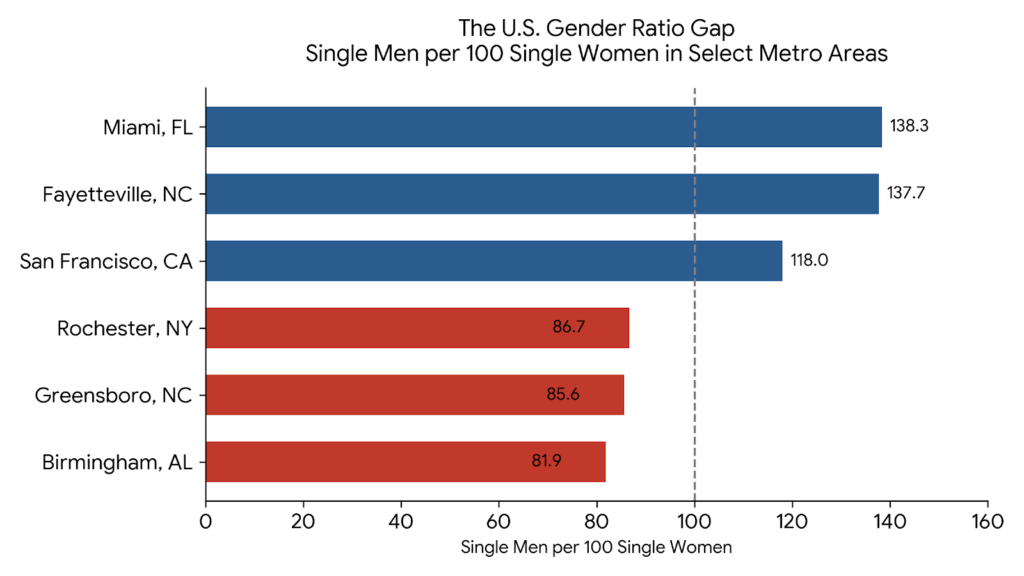
The investigative “so what” becomes most acute when examining the Great Lakes “Singlehood Hubs.” In metropolitan centers like Detroit (58.5%), Cincinnati (56.9%), Rochester (56.7%), Syracuse (56.5%), and Pittsburgh (56.0%), the “never-married” population has evolved from a minority cohort into the dominant demographic force.
In Detroit, a 58.5% never-married rate is far more than a fun piece of social trivia; it signals an urban economy where real estate revitalization is consistently undercut by a shortage of dual-income home-buying households. Municipal tax bases in these cities are forced to rely heavily on volatile, single-earner revenue streams rather than the predictable intergenerational wealth accumulation typical of family-centric suburban zones. While these stark domestic ratios define the American interior, the search for meaningful connection increasingly drives modern, mobile professionals toward international romantic markets.
From Madrid to the Tinder Capitals
In today’s hyper-connected, remote-capable global economy, “holiday romances” are rarely accidental anymore; they are strategically targeted. International dating hubs have transformed into critical nodes for individuals looking to expand both their personal networks and lifestyle opportunities across foreign borders. Unpartnered travelers increasingly leverage crowdsourced indices and geolocation data to evaluate a destination’s social inclusivity, safety, and nightlife vitality long before stepping onto a plane.
Synthesized metric analyses derived from joint travel and dating app datasets—including travel studies by Icelandair alongside Tinder Passport geolocation trends—highlight three primary global victors for finding connection:
Madrid, Spain (Overall Index: 86.34): Madrid tops global rankings as the premier destination for singles. Its dominant standing is propelled by an exceptional nightlife index (85.90) paired with a world-leading LGBTQ+ inclusivity rating of 91.69, making it an exceptionally welcoming destination for diverse dating demographics.
London, England: Operating as both a premier global financial center and an international dating powerhouse, London leads as the #1 destination globally for Tinder Passport users. The capital’s vast public transit accessibility and culturally permissive atmosphere allow mobile professionals to digital “pre-date” weeks before landing at Heathrow.
Prague, Czech Republic: Achieving a rare 100.0 perfect rating for nightlife, Prague seamlessly blends architectural romance with a high-energy social landscape that strongly favors adventurous travelers and expatriates.
The Parisian Paradox
Interestingly, the data exposes a glaring failure: Paris. Long mythologized as the world’s absolute “City of Love,” Paris plummeted to a dismal 21st place in modern data rankings. This sharp underperformance stems from major gaps in modern social infrastructure, including a lackluster nightlife score of 34.60 and an LGBTQ+ friendliness score (74.23) that trails far behind rival European capitals like Madrid and London.
Finding a potential partner in these vibrant international hubs represents only the first variable in the demographic equation, however; the long-term structural stability of those relationships uncovers even deeper socio-economic divides across regional landscapes.
Peaks of Stability and Divorce
Stripped of sentimental idealization, marriage operates in macroeconomics as a foundational financial contract. Married populations statistically report higher median household incomes, greater net worth accumulation, and favorable tax-filing efficiencies that provide a resilient buffer against macroeconomic volatility. Conversely, elevated regional divorce rates frequently reflect systemic localized economic stress, structural employment instability, or cultural shifts that fragment shared household economies of scale.
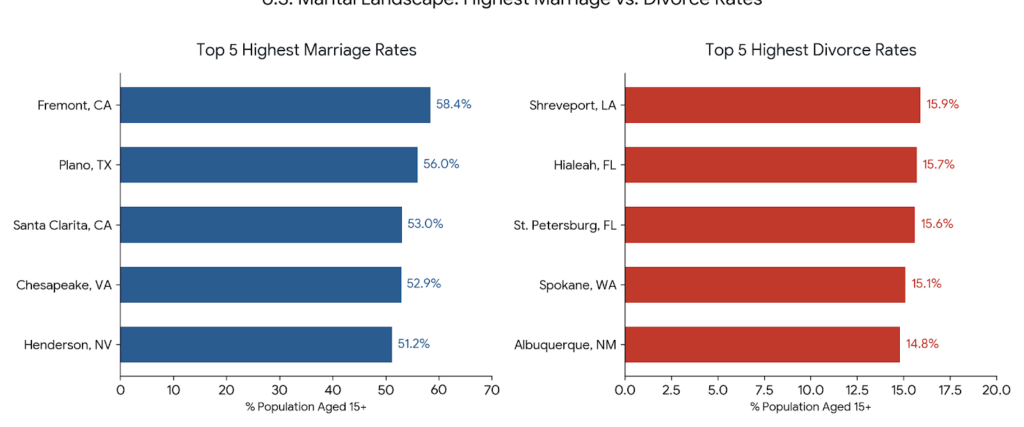
Analysis of Census metrics reveals a striking phenomenon known as the “Fremont Anomaly” in Northern California. Nearly 58.4% of Fremont’s adult population is actively married—the highest rate among all major U.S. cities evaluated. Powered by high tech-sector median incomes, excellent public school funding, and real estate stability, Fremont pairs its high marriage rate with a rock-bottom divorce rate of just 5.8%.
This stands in stark contrast to high-divorce metro regions such as Shreveport, Louisiana (15.9%) and Hialeah, Florida (15.7%). In these cities, marital dissolution occurs at nearly three times the rate observed in Fremont, signaling vastly different local wage dynamics, financial pressures, and community safety nets.
Comparative Regional Profiles
 Hidden Nuances and Data Gaps
 Hidden Nuances and Data Gaps
For the seasoned investigative journalist, data integrity is paramount. Standard “Best Cities for Singles” listicles routinely obscure complex behavioral realities. Blindly relying on surface-level Census figures can lead individuals to misinformed personal relocations and flawed economic assumptions.
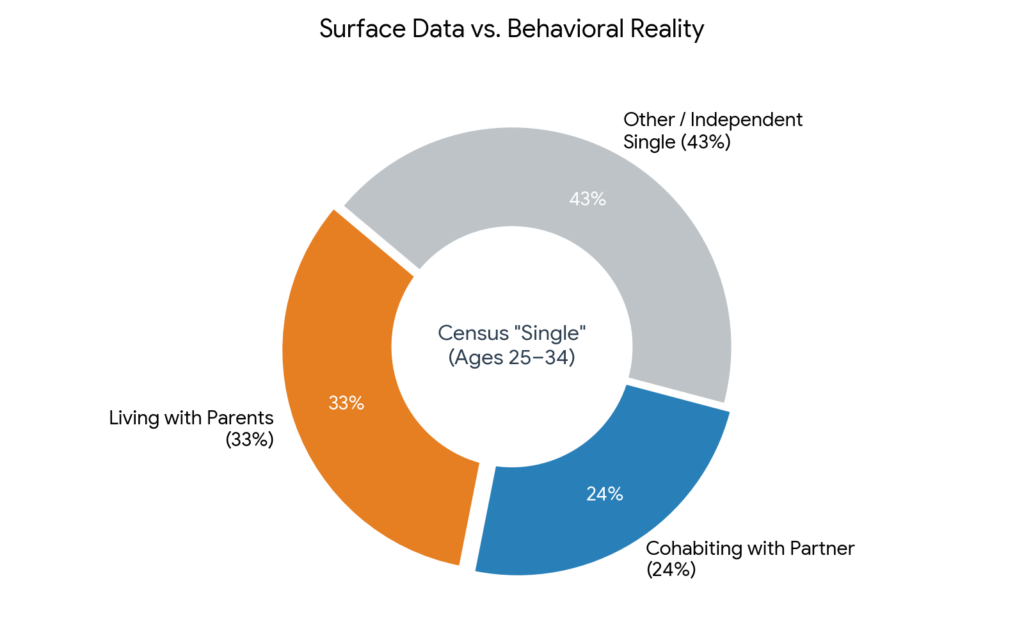 A rigorous audit reveals three critical analytical flaws inherent in traditional dating metrics:
Millennial Cohort Masking: Standard U.S. Census Bureau data routinely categorizes unpartnered individuals in the 25–34 age bracket as “single.” However, deep-dive sociological studies confirm that roughly 24% of this subgroup are actually cohabiting full-time with a romantic partner. Furthermore, approximately one-third of this same age group lives at home with parents—a structural economic variable that largely removes them from active, independent dating markets.
The Adjusted Employment Filter: Pew Research surveys indicate that over 80% of single women prioritize financial stability and steady employment when evaluating potential long-term partners. This preference renders raw male-to-female gender ratios deceptive. In elite tech corridors like San Jose or Santa Clara, while the raw gender ratio seems slightly imbalanced, the “effective ratio” skyrockets to 114 employed single men for every 100 single women, creating far higher competition than raw population totals suggest.
Closing the LGBTQ+ Data Gap: Historically, social stigma, privacy risks, and safety concerns caused severe underreporting in LGBTQ+ demographic sampling within cities like San Francisco, Atlanta, and Seattle. As legal protections expand and cultural acceptance grows, modern census tools and localized survey methods are finally capturing true non-heteronormative demographic densities, offering a far more accurate picture of urban dating landscapes.
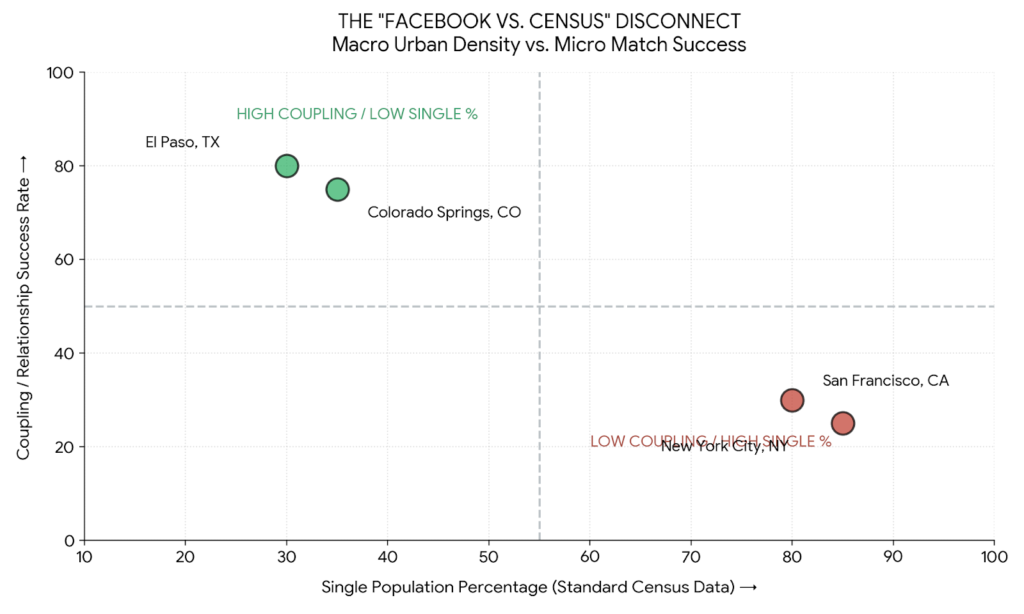 This statistical discrepancy highlights a fundamental truth: mega-cities like New York and San Francisco boast huge volumes of single residents, yet record some of the lowest rates of actual relationship formation. Conversely, mid-sized or traditionally family-oriented cities like Colorado Springs and El Paso display significantly higher rates of users shifting social media relationship statuses to “In a Relationship,” proving that sheer population density does not guarantee romantic conversion.
The Role of Behavioral Statistics
Navigating complex human dynamics requires grounding intuition in rigorous statistical methodologies. To an investigative analyst or social scientist, the research framework taught in foundational behavioral statistics—such as Taft College’s PSYC 2200 curriculum—is not an abstract academic exercise; it provides the essential toolkit required to separate factual trends from popular narrative noise. Measuring operational variables and calculating correlation coefficients empowers practitioners across disciplines—from family therapists and sociologists to urban planners and municipal policymakers—to validate whether community interventions are truly working.
Modern social science is increasingly relying on the rigorous five-step scientific method to transform complex societal questions into actionable, data-driven insights. The process begins with the generation of a precise research question—such as examining whether a city’s average wage level serves as a reliable predictor for its local marriage rates—which establishes a clear scope for investigation. Following this initial inquiry, researchers formulate a testable hypothesis that clearly predicts the nature and strength of the expected correlation between the selected economic and demographic variables.
To test this potential relationship, sociologists and economists gather empirical data, ensuring that variables such as income thresholds and marriage licenses are precisely defined and recorded across diverse populations. Once the raw data is compiled, advanced statistical analyses are conducted to test for significance, helping researchers determine whether observed patterns represent true societal trends or merely coincidental anomalies. Finally, the research cycle culminates in publicizing the findings to academic journals, civic leaders, and the broader community, ensuring that empirical evidence can directly inform public policy, economic strategy, and community initiatives.
Applied Methodology Breakdown
Generate a Research Question: Formulate a targeted, quantifiable inquiry into social behavior (e.g., “Does a city’s median household income level directly predict its marital stability rate?”).
Formulate a Research Hypothesis: Establish a clear, testable, and directional statement predicting the relationship between independent and dependent variables without qualitative assumptions.
Collect Empirical Data: Gather standardized metrics using structured methodologies (such as Census sampling, behavioral tracking, or geolocation surveys) to systematically measure defined variables.
Analyze Data Outputs: Evaluate statistical significance, run regressions, and determine whether empirical results support or refute the initial hypothesis.
Publicize the Results: Publish peer-reviewed findings, research reports, and investigative journalism to inform public policy, guide municipal planning, and elevate societal literacy.
Ultimately, while matters of the heart remain inherently personal, the science of behavioral statistics provides the only reliable roadmap through society’s collective trends. Hard data possesses a unique ability to illuminate human connection—provided we have the statistical literacy to look past simple listicles and confront the socio-economic realities underneath.
Never miss a beat of the, a strategy, or a reality check. Make sure you are plugged into the network to never miss an episode of the 21st Century Dating Decoded!:
🎧 Listen on the Go: Find your preferred audio match on Apple Podcasts, Spotify, YouTube Music, Amazon Music, Audible, iHeart Radio, or Deezer.
📺 Watch on Speed Mingle TV: Access premium video content on YouTube, Roku, Amazon Fire TV (just search for “Speed Mingle TV Network” within the apps & games interface), or via the HRB TV Network.
🌐 Engage & Subscribe: Secure your access to all future segments directly at 21stcenturydatingdecoded.com.
If you valued this episode and found our discourse on abandoning prescribed dating narratives informative, please take a few seconds to support our community:
Activate the subscription button immediately so you never miss an episode.
Leave a five-star review to assist other growth-minded singles in discovering our program.
Share this link with an acquaintance who desperately needs it—especially that friend who continues to utilize an outdated, poorly illuminated headshot enhanced with an expired digital filter. Forward them the link; their future romantic prospects will thank you.
Take the initiative today. Secure your reservation at an upcoming Speed Mingle event in your vicinity, and get ready to Mix, Match, and Mingle to enhance your social portfolio.
Thank you for your listenership and viewership of 21st Century Dating Decoded! Until our subsequent episode: remain deliberate, maintain protection, and consistently date with a defined purpose.
#21stCenturyDatingDecoded #LocationLocationLove #ZipCodeDating #SpeedMingle #DatingAdvice #ModernDating #Relationships #DatingPodcast #SpeedDating #IntentionalDating