

Speed Mingle News
Mind the Chasm: Culture, Marriage, and Unintended Consequences
Published on Sunday, July 26, 2026
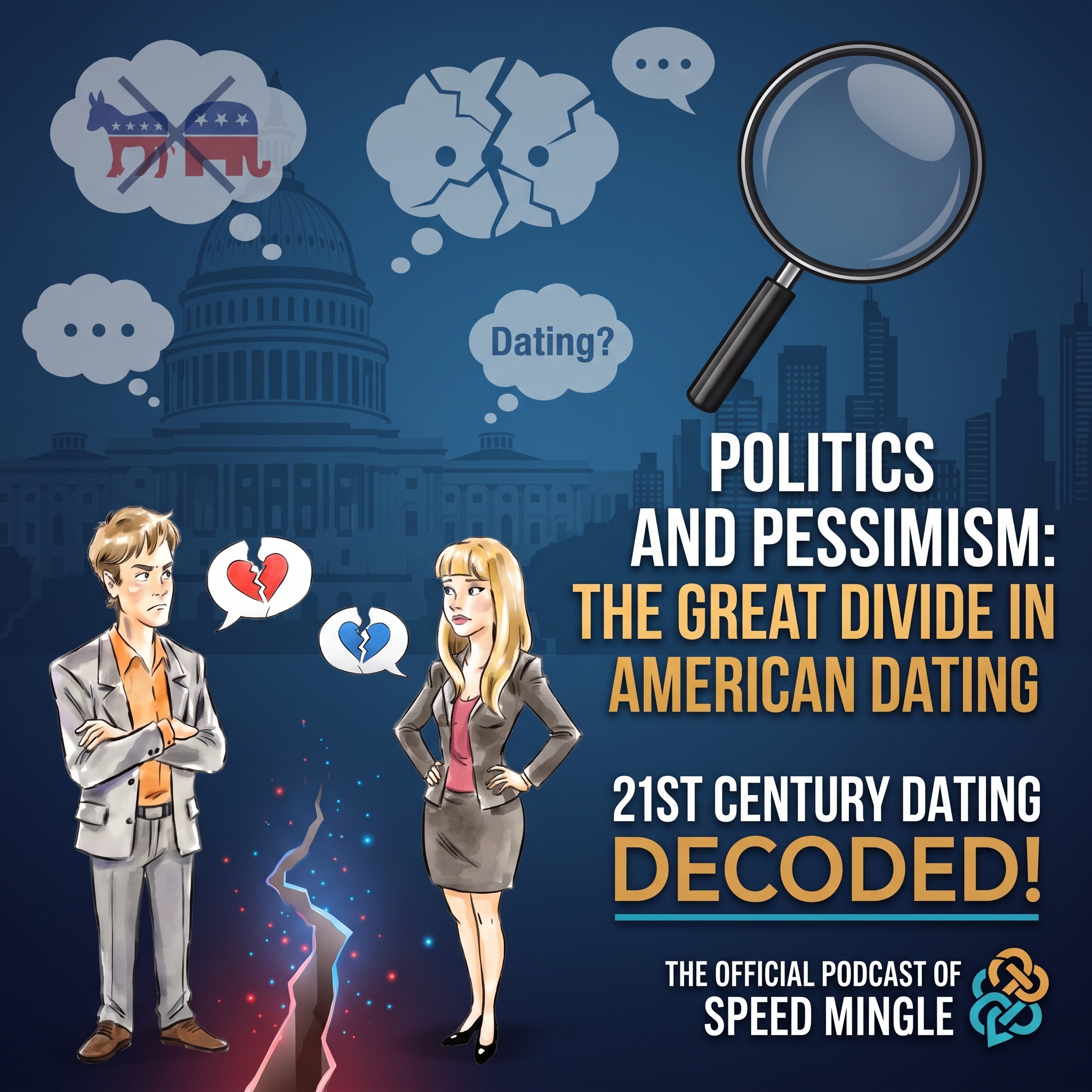
Across the contemporary American social landscape, a fundamental structural realignment is quietly unfolding—one defined not by geographical secession or physical conflict, but by a profound disintegration of a shared social reality. For over a century, the foundational stability of Western society was anchored by a synchronized progression into adulthood. Young men and women moved through life stages in relative cultural tandem: completing formal education, securing economic self-sufficiency, establishing dual-income households, and forming lasting family units. In the modern era, that historical synchronization has collapsed into a series of stark ideological fractures. Young adults are increasingly retreating into opposing ideological spheres, initiating a broad demographic phenomenon known as the Great Divergence. Far from a transient shift in youth voting patterns or media preferences, this divergence constitutes a major structural rupture in the nation’s demographic architecture. As young women move decisively toward progressive social ideals while young men remain anchored in moderate or conservative worldviews, the foundational values required for enduring civic and personal partnerships are eroding into a fifteen-point chasm of mutual skepticism and institutional alienation.
The Great Divergence and the Ideological Rift
Empirical observations demonstrate that political and cultural insulation has evolved from a matter of routine intellectual debate into a primary structural barrier to domestic partnership and family formation. According to longitudinal demographic research conducted by Gallup, approximately 40 percent of young women between the ages of 18 and 29 currently self-identify as liberal—a rapid upward trend over the past decade that has opened an unprecedented fifteen-percentage-point gap with their male counterparts, of whom only 25 percent claim the same political affiliation. Data compiled by the Institute for Family Studies indicates that this ideological drift directly dictates patterns of marital formation and long-term domestic stability. Today, a clear majority of young unmarried liberals remain single, whereas educated conservative men and women demonstrate a 50 percent higher likelihood of entering into formal marriage.
Furthermore, a profound rift has emerged regarding the perceived societal necessity of the family unit itself. Among college-educated demographics, over 70 percent of young men express a conviction that children require a two-parent married household for optimal psychological and economic development, compared to merely 30 percent of their female peers. This ideological divergence functions as a form of rigorous cultural sorting, giving rise to a notable paradox in contemporary social commentary: while high-income, highly educated elites frequently downplay the traditional nuclear family in academic and public spheres, they overwhelmingly practice traditional family formation within their private lives. As a consequence, the shared worldviews necessary for stable, long-term household creation are becoming concentrated almost exclusively within conservative cohorts. For the broader population, the dating landscape has transformed into an arena of intense political friction, wherein interpersonal intimacy is routinely filtered through academic frameworks centered on power dynamics, historic oppression, and zero-sum conflict. This climate has fostered the rise of “heteropessimism”—a defensive, strategic skepticism that frames male-female partnership not as a source of mutual support and social stability, but as an inherent operational risk to individual autonomy.
From Skepticism to Separation: The 4B Movement and Male Withdrawal
The transition from routine dating frustration to organized anti-partnership philosophies marks a radical shift in modern gender relations. This transition is clearly illustrated by the Western adoption of extreme international fringe movements, most notably South Korea’s 4B movement. Founded upon four central tenets—the total rejection of marriage (bihon), childbirth (bichulsan), romance (biyeonae), and sexual relationships with men (bisekseu)—the 4B ideology frames complete social and romantic separation from men as the ultimate expression of female liberation. Although the movement’s influence has waned in its country of origin amid an alarming national demographic crisis, its rhetoric has circulated globally through modern digital platforms, popularizing the concept of “de-centering men” from female life planning and long-term economic strategy.
Concurrently, social analysts observe that this anti-partnership rhetoric operates within a broader cultural environment that has grown increasingly alienating to young men. The resulting phenomenon, described by researchers as Institutional Checking Out, represents a widespread, systemic withdrawal of young men from higher education, high-effort career trajectories, and the romantic marketplace. Multiple structural drivers accelerate this male retreat, including pervasive media tropes that portray fathers as domestic liabilities, the broad application of terms like “toxic masculinity” to standard male behavioral traits, and a measurable, multi-decade decline in male academic performance. Men currently constitute barely 40 percent of undergraduate students enrolled in American higher education, leading to a shrinking pool of economically stable candidates who possess the traditional criteria sought for long-term domestic partnership. By converting the romantic marketplace from a venue of mutual compromise into a space of active avoidance, these movements inadvertently dismantle the systems of intergenerational safety and economic coordination that historically protected both sexes from social instability.
The Economic Paradox of Single-Income Wealth Accumulation
In the residential real estate market, single women have made substantial quantitative gains, fueling a popular narrative of “income inversion” that implies total economic dominance and independent financial security. Comprehensive data from the National Association of Realtors and the National Association of Exclusive Buyer Agents reveals that single women are entering the real estate market at higher rates and with greater purchasing power than single men. The median income for single female first-time homebuyers has reached $73,000, compared to $66,400 for single men. Nationwide, single women own 11.14 million homes compared to 8.42 million owned by single men—a substantial lead of 2.72 million properties—and hold homeownership dominance in 47 out of 50 states. Many single women utilize fixed-rate residential real estate as a forced savings mechanism designed to shield personal housing costs against broader inflationary pressures.
However, these real estate milestones obscure a significant, long-term financial limitation: the absolute loss of the dual-income wealth multiplier. Single-income households, regardless of individual professional achievement, lack the structural asset-pooling and cost-sharing mechanisms inherent to married life. Married couples benefit from shared fixed overhead expenses, favorable tax bracket thresholds, capital gains exemptions, and built-in financial loss absorption during periods of unemployment, medical emergency, or broader economic contraction. Without the capacity to split living costs and pool liquid capital, single homeowners frequently find themselves asset-rich but cash-constrained, facing heightened exposure to macroeconomic volatility. Consequently, long-term economic studies confirm that married households consistently accumulate significantly higher lifetime net worth across every income bracket compared to their lifelong single counterparts.
The Loneliness Paradox and Kinship Contraction
To evaluate the psychological and social consequences of these shifting domestic patterns, sociologists frequently reference the research of Dr. Janosch Schobin regarding the “Emancipation Dividend.” The expansion of gender equality, individual career mobility, and legal flexibility—such as the implementation of no-fault divorce laws—allows individuals to exit unfulfilling or high-conflict relationships with relative ease. As a direct consequence, the marriages that do persist tend to be self-selected, higher in overall quality, and characterized by deeper levels of emotional support and mutual respect.
However, this emancipation dividend produces a severe secondary counter-effect known as the Loneliness Paradox. As personal mobility rises and birth rates experience a sustained decline, broader kinship networks—encompassing siblings, cousins, and extended family structures—are rapidly contracting across Western societies. Consequently, modern adults increasingly concentrate their entire emotional expectation onto a single romantic partner or, in the case of lifelong single individuals, onto temporary peer networks that naturally dissipate over time due to career relocations, aging, and changing life priorities. Empirical data from the Institute for Family Studies consistently indicates that married individuals report significantly higher rates of overall life satisfaction and psychological well-being than their single peers. While career achievements and individual autonomy offer temporary validation, they rarely serve as a permanent substitute for the sustained social safety net and generational continuity provided by a committed family structure.
The Scarcity Trap and Demographic Instability
The ideological choices made during early adulthood frequently create a structural Scarcity Trap in middle and late life. Frameworks that dismiss domestic partnership or view men as inherently adversarial eventually collide with immutable biological realities, shrinking romantic options, and shifting demographic conditions over time. The scarcity trap manifests through three distinct structural constraints:
Fertility Barriers: The cultural encouragement to delay or permanently forgo partnership during peak reproductive years frequently results in severe biological hurdles and complex medical interventions when the desire for family formation emerges later in life.
Partner Deficits: As individuals enter their mid-30s and 40s, the pool of compatible, stable partners shrinks dramatically—a deficit severely exacerbated by the widespread educational and workforce retreat of young men in previous decades.
Late-Life Isolation: Short-term social networks, such as workplace colleagues and casual social acquaintances, inevitably disperse over time, leaving single individuals without built-in caregiving systems, domestic support, or intergenerational family structures during senior age.
This dynamic deepens a broader socio-economic divide across the nation. Elite, highly educated populations continue to marry, pool capital, and secure their long-term financial stability, while less affluent populations absorb a disproportionate share of the economic volatility, social isolation, and structural vulnerability associated with long-term singlehood.
Restoring the Partnership Model
Bridging the 15-point ideological chasm requires a fundamental cultural transition away from zero-sum gender dynamics toward a framework centered on mutual dependency and institutional trust. The contemporary trajectory of ideological polarization, anti-male rhetoric, and widespread institutional withdrawal has failed to deliver its promised individual liberation, resulting instead in widespread social atomization, declining birth rates, and heightened economic exposure. Addressing these structural challenges requires several deliberate societal adjustments:
Moving Beyond Zero-Sum Frameworks: Interpersonal relationships must be removed from ideological frameworks that evaluate human intimacy solely through the lens of systemic oppression, replacing them with models emphasizing collaboration, mutual respect, and shared long-term objectives.
Reaffirming the Value of Marriage: Cultural, educational, and civic leaders must publicly acknowledge what empirical data consistently confirms: that durable, dual-income marriages remain the single most effective institutional mechanism for lifetime wealth accumulation, child well-being, and social stability.
Re-engaging Young Men: Academic and civic institutions must actively address the root causes of male academic and workforce decline, ensuring that young men are integrated back into higher education and career pathways as capable, productive, and accountable partners in society.
The empirical record remains unambiguous: formal marriage and family formation are not historical regressions to be overcome. They represent the most reliable, time-tested mechanisms for securing long-term economic resilience, psychological flourishing, and social cohesion. Rebuilding the partnership model is not an attempt to retreat into the past, but an essential strategic requirement for securing a stable and prosperous future.
Never miss a beat of the, a strategy, or a reality check. Make sure you are plugged into the network to never miss an episode of the 21st Century Dating Decoded!
Listen on the Go: Find your preferred audio match on Apple Podcasts, Spotify, YouTube Music, Amazon Music, Audible, iHeart Radio, or Deezer.
Watch on Speed Mingle TV: Access premium video content on YouTube, Roku, Amazon Fire TV (just search for “Speed Mingle TV Network” within the apps & games interface), or via the HRB TV Network.
Engage & Subscribe: Secure your access to all future segments directly at 21stcenturydatingdecoded.com.
If you valued this episode and found our discourse on abandoning prescribed dating narratives informative, please take a few seconds to support our community:
Activate the subscription button immediately so you never miss an episode.
Leave a five-star review to assist other growth-minded singles in discovering our program.
Share this link with an acquaintance who desperately needs it—especially that friend who continues to utilize an outdated, poorly illuminated headshot enhanced with an expired digital filter. Forward them the link; their future romantic prospects will thank you.
Take the initiative today. Secure your reservation at an upcoming Speed Mingle event in your vicinity, and get ready to Mix, Match, and Mingle to enhance your social portfolio.
Thank you for your listenership and viewership of 21st Century Dating Decoded! Until our subsequent episode: remain deliberate, maintain protection, and consistently date with a defined purpose.
#21stCenturyDatingDecoded #MindTheChasm #DatingIn2026 #ModernRomance #MarriageGap #Relationships #DatingCulture #GenderDynamics #SocialTrends #PodcastEpisode #SingleLife #EconomicReality