

Speed Mingle News
The Magic City Matchup: Speed Dating vs. Speed Mingle
Published on Wednesday, August 19, 2026
As the clock struck eight on a humid Thursday evening, a distinct movement began to pulse through Birmingham’s historic Loft District. While much of the city remained tethered to the familiar blue-light glow of smartphones, more than 150 local residents staged a quiet, deliberate coup against the digital status quo.
The gathering was far more than a typical weekend social mixer; organizers framed it as part of the “Great Offline Migration”—a strategic exodus from the pervasive “swiping fatigue” that has transformed modern dating into a wearying, administrative second job. Within the brick-and-mortar reality of a downtown venue, the theoretical efficiency of the dating algorithm hit a psychological boiling point, prompting a collective return to the high-definition sensory data of face-to-face interaction.
The crowd, an energetic cross-section of Avondale creatives and Lakeview corporate professionals, sought to reclaim the subtle nuances of human chemistry—the unquantifiable “vibe”—that a flat, two-dimensional digital profile simply cannot transmit. Yet, as the evening progressed, it became increasingly clear that this return to physical social spaces is divided between two sharply competing philosophies of human connection.
BINARY ANXIETY VERSUS FLUID AMBIGUITY
The live social experiment within the venue was divided into two distinct zones, testing the immediate impact of the “Romantic Sprint” against the open-ended “Social Flow.”
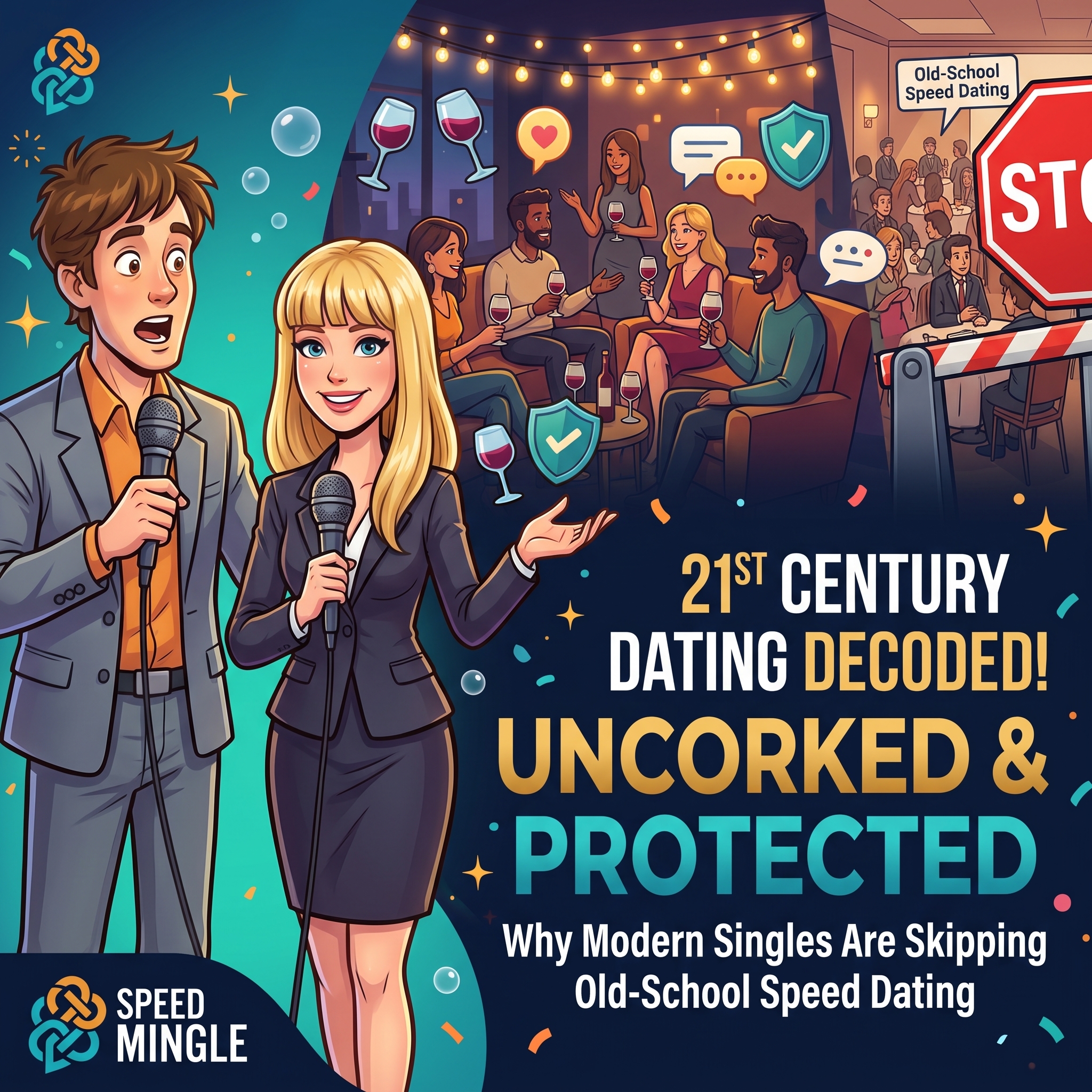
In the first room, participants engaged in the high-stakes environment of traditional Speed Dating, a format where mutual romantic chemistry is evaluated through strictly timed rotations of exactly four minutes. While this structure offers targeted efficiency for individuals entering the room with singular, clear romantic intentions, it carries a noticeable psychological cost: the acute anxiety of a binary choice.
Because the scorecard demands an immediate “yes” or “no” evaluation after every micro-interaction, the air in the room was thick with a nervous, interview-like intensity that frequently triggered rapid conversational burnout. Many participants found themselves trapped in a repetitive loop of biographical interrogation, reciting the same career milestones and origin stories until the organic humanity of the encounter began to feel almost industrial.
In the adjacent room, the atmosphere shifted dramatically to the casual, self-directed chaos of the Speed Mingle. Here, countdown timers were replaced by interest-based interaction zones and guided icebreakers, prioritizing a fluid, multi-track social environment over an exclusive, high-pressure romantic focus.
This format offers a significantly higher level of psychological comfort by intentionally introducing ambiguity. Because the stated goal of an interaction can encompass friendship, local community-building, or professional networking just as easily as romance, the artificial pressure to spark instantly evaporates. While Speed Dating provides the certainty of an immediate, standardized scorecard, the Speed Mingle allows romantic potential to emerge organically from a broader platonic foundation.
The structural trade-off was stark: one room offered the direct, if inherently stressful, pursuit of a single partner, while the other offered a multidimensional expansion of one’s broader social ecosystem—where romance serves as a possible, though never guaranteed, by product.
INTENTIONALITY AS A DEMOGRAPHIC DEFENSE
Detailed post-event questionnaire results released by the event hosts revealed a stark demographic schism in how these competing formats are consumed by different age brackets.
The 30-and-older cohort showed an overwhelming, decisive preference for the structured efficiency of the speed dating room, while the 21–29 age group gravitated en masse toward the relaxed, “house party” energy of the unscripted mingle.
For Marcus Vance, a 31-year-old mechanical engineer attending the event, the preference for structured speed dating functions as a tactical defense mechanism against more than a decade of digital disappointment. For Vance and his peers, discretionary personal time is viewed as an increasingly finite resource. The speed dating format allows participants to bypass weeks of unproductive, asynchronous messaging on mobile applications to gauge actual physical chemistry within the first two minutes of conversation.
Conversely, 28-year-old Elena Torres exemplified the “friendship first” mindset that characterizes the younger demographic. Having recently emerged from a long-term relationship, Torres viewed the event not as an urgent dating pool, but as a low-stakes mechanism to rebuild her local social network, explicitly seeking “group-chat friends” rather than immediate suitors.
This generational split suggests that the strategic prioritization of explicit “clear intentions” is often a direct byproduct of age, as older singles actively seek to eliminate the ambiguous guesswork that characterized their earlier adult years. While younger participants are principally focused on cultivating a broad, flexible social circle, the 30-plus demographic is engaged in a precise romantic rescue mission, leveraging enforced structure to safeguard their limited time and emotional bandwidth.
LEGAL SCRUTINY AND THE ALGORITHM’S RETREAT
This ongoing migration toward Birmingham’s offline venues is being further propelled by a profound, systemic erosion of public trust in major digital platforms, recently punctuated by significant legal repercussions across the tech industry.
The landmark $60.5 million class action settlement in Candelore v. Tinder, Inc. served as a definitive wake-up call for consumers who increasingly feel reduced to exploitable data points by subscription-based matchmaking applications. The federal lawsuit alleged that Tinder violated California’s Unruh Civil Rights Act and Unfair Competition Law by engaging in overt, age-based pricing discrimination. Specifically, the settlement covers users who purchased premium Tinder Plus or Tinder Gold subscriptions in California on or after March 2, 2015, if they were over the age of 29, or on or after March 2, 2016, if they were over the age of 28.
High-profile legal outcomes of this scale have provided a powerful structural “push factor” for regional offline social movements like the one gaining momentum in Birmingham. When interpersonal intimacy is aggressively commodified through discriminatory tier pricing—effectively penalizing older users financially for the exact same premium features—the perceived “magic” of the matching algorithm is revealed to be a cold, profit-driven corporate calculation.
Public skepticism toward automated matchmaking is no longer a niche consumer grievance; it has matured into a mainstream realization that digital dating platforms often operate with inherent, systemic biases built into their business models. Consequently, the legal and civil rights violations debated in federal courtrooms are being directly answered on the ground in local communities. Singles are returning to physical brick-and-mortar spaces where the cost of entry is uniform, transparent, and equal, and where interpersonal interactions are governed by authentic human intuition rather than proprietary, commercially motivated software code.
THE INDUSTRIALIZATION OF INTIMACY IN THE WORKPLACE
As these newly ignited romantic sparks follow participants from weekend lounges directly back to their Monday morning office desks, the offline migration has simultaneously forced a rapid modernization of corporate ethics and human resources policies across the region.
Modern employers are increasingly moving away from historically unenforceable, sweeping dating bans, transitioning instead toward sophisticated, formal frameworks of disclosure designed to protect the structural integrity and psychological safety of the workplace.
The primary operational objective of these updated policies is the systemic prevention of implicit favoritism, conflicts of interest, and workplace harassment. By mandating that employees proactively disclose romantic relationships to human resources departments, organizations can preemptively reassign management hierarchies and modify reporting structures before professional conflicts arise.
These formal organizational guardrails—which frequently include mandatory consensual relationship agreements, confirmation meetings, and clear anti-retaliation provisions—have become vital operational tools for maintaining corporate health when interpersonal boundaries inevitably blur.
The broader legal landscape now directly reflects this corporate imperative for structured oversight, with an expanding list of state jurisdictions enacting strict, statutory training mandates:
New York State: Mandates annual, comprehensive sexual harassment prevention training for all employers operating within the state, regardless of total company size or employee count.
California: Requires specialized, interactive harassment prevention training for all businesses employing five or more individuals, with specific content thresholds for supervisory staff.
Illinois & Maine: Have instituted statewide legislative requirements obligating employers to conduct regular, documented workplace boundary and harassment training for all active staff members.
By integrating these rigid legal guidelines, contemporary corporations are attempting to systematically manage the “industrialization of intimacy.” The goal is ensuring that even as human romance moves decisively back into the physical world, statutory protections against professional retaliation, favoritism, and harassment remain non-negotiable and strictly enforced.
THE SCIENCE OF SYNCHRONIZED DISCLOSURE
To successfully bridge the gap between structured efficiency and casual social interaction, Birmingham event hosts are increasingly incorporating empirical social psychology into their programming—specifically the peer-reviewed science of reciprocal self-disclosure.
Central to the success of the Loft District event was the deployment of the “52+2 Conversation Catalyst” card system, an instructional tool explicitly engineered to bypass the shallow, exhausting small talk that defines both digital messaging and standard networking events. Drawing directly upon empirical research established in the landmark Sprecher study of 2013, the exercise facilitates what sociologists term “coordinative closeness” through a synchronized, structured deepening of interpersonal questions.
Unlike a traditional, asymmetrical interrogation where one participant systematically grills the other, this scientifically backed framework relies entirely on the immediate reciprocity of vulnerability. Over the course of a focused five-minute conversational arc, participants move seamlessly from a playful icebreaker—such as describing their current “personality weather forecast”—to a carefully structured, highly revealing “wildcard” inquiry regarding an unexpected personal skill or core value.
This methodical system of grouping individuals by communication style, personal values, and energy levels ensures that authentic rapport is built through mutual, sustained attention rather than a dry exchange of basic resume bullet points. The core analytical takeaway for event organizers is profound: open-ended, narrative-driven prompts consistently outperform traditional background questioning by surfacing personal values, emotional intelligence, and genuine personality traits with far greater velocity.
By strategically integrating these conversational catalysts, organizers effectively eliminate the cold “job interview” atmosphere that plagues traditional singles events. The process shifts the fundamental nature of the room, transitioning the baseline interaction from a transactional “What do you do for a living?” to a far more profound, humanizing “What makes you feel most like yourself?”—rapidly converting a room full of isolated strangers into a cohesive, functioning social ecosystem.
OUTLOOK: THE HIGH-DEFINITION REVOLUTION
The emerging Birmingham social landscape currently stands at the absolute vanguard of a broader, Southeast-wide relaunch of the “Connection Revolution.”
With the rapid regional expansion of privacy-focused matching systems like Speed Mingle SmartSync™ alongside specialized, activity-centered gatherings such as “Shuck & Socialize,” the trajectory of modern socialization is moving decisively toward a permanent, self-sustaining ecosystem of in-person interaction.
This cultural shift is ultimately defined by the concept of “Truecasting”—the deliberate prioritization of radical, uncurated, and raw physical authenticity over the highly polished, artificially curated, and frequently misleading digital personas that have dominated the personal relationship market for the last decade.
As these real-world event formats continue to establish permanent roots across major metropolitan areas, they signal a future where human social circles are built upon shared foundational values, real-time psychological safety, and the undeniable, electric energy of a physical room. In the Magic City, the tyranny of the dating algorithm is finally losing its grip to the vibrant, high-definition reality of human presence.
Never miss a beat of the, a strategy, or a reality check. Make sure you are plugged into the network to never miss an episode of the 21st Century Dating Decoded!
🎧 Listen on the Go: Find your preferred audio match on Apple Podcasts, Spotify, YouTube Music, Amazon Music, Audible, iHeart Radio, or Deezer.
📺 Watch on Speed Mingle Network: Access premium video content on YouTube, Roku, Amazon Fire TV (just search for “Speed Mingle Network” within the apps & games interface), or via the new mobile web app @ SpeedMingle.mobi.
🌐 Engage & Subscribe: Secure your access to all future segments directly at 21stcenturydatingdecoded.com.
If you valued this episode and found our discourse on abandoning prescribed dating narratives informative, please take a few seconds to support our community:
1️⃣ Activate the subscription button immediately so you never miss an episode.
2️⃣ Leave a five-star review to assist other growth-minded singles in discovering our program.
3️⃣ Share this link with an acquaintance who desperately needs it—especially that friend who continues to utilize an outdated, poorly illuminated headshot enhanced with an expired digital filter. Forward them the link; their future romantic prospects will thank you.
Take the initiative today. Secure your reservation at an upcoming Speed Mingle event in your vicinity, and get ready to Mix, Match, and Mingle to enhance your social portfolio!
Thank you for your listenership and viewership of 21st Century Dating Decoded! Until our subsequent episode: remain deliberate, maintain protection, and consistently date with a defined purpose. 💡✨
#21stCenturyDatingDecoded #SpeedMingle #ModernDating #DatingDecoded #TheMagicCityMatchup #BirminghamAL #SpeedDating #SpeedMingle #OfflineDating #DatingStrategy #Relationships #RealConnection #Matchmaking #DatingAdvice #SingleLife #PodcastEpisode #DateWithPurpose