

Speed Mingle News
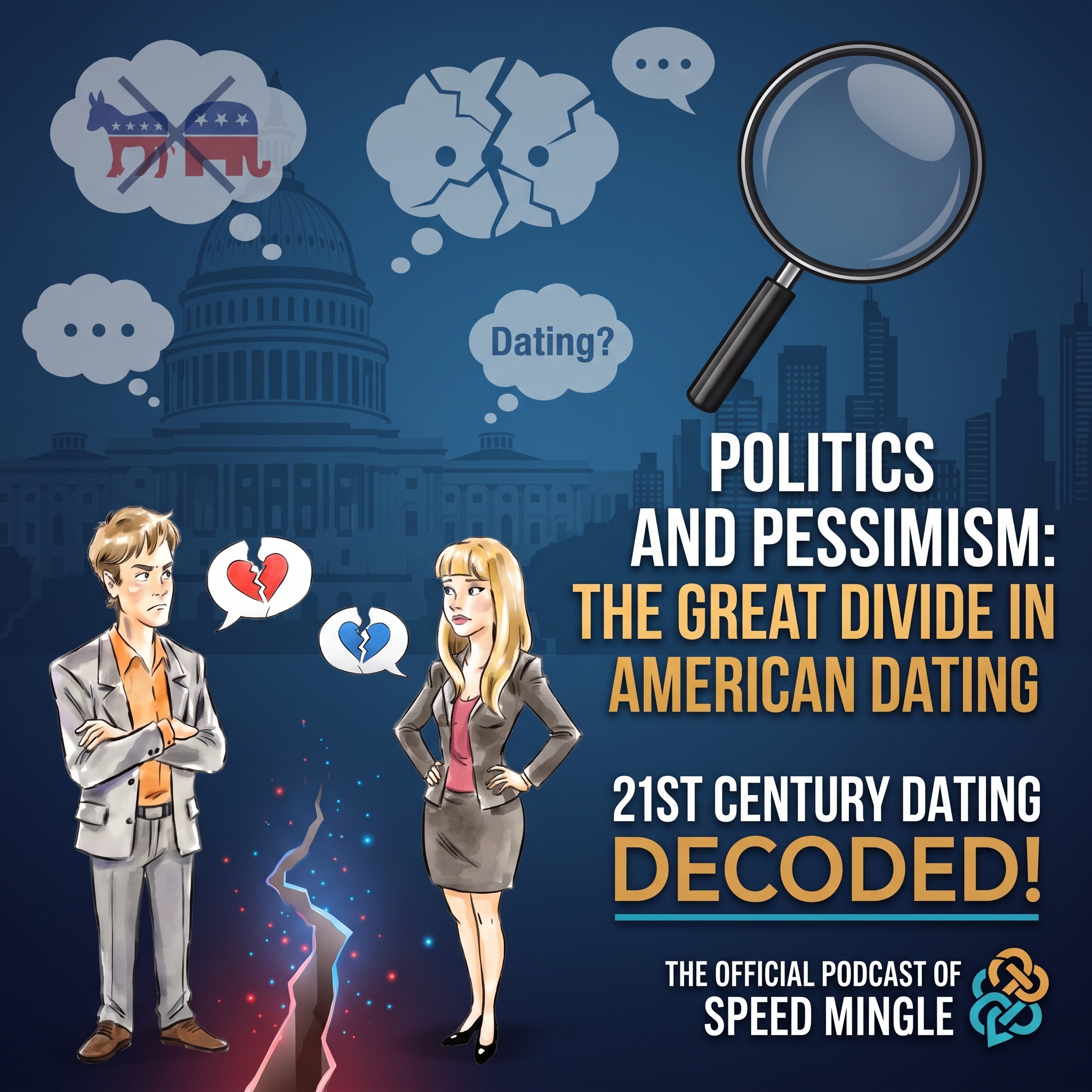
Politics and Pessimism: The Great Divide in American Dating
Published on Sunday, September 6, 2026
In a national dating ecosystem increasingly defined by partisan friction, political identity has transformed from a subtle background detail into a non-negotiable moral filter. For millions of single Americans, traditional dealbreakers like career ambitions or lifestyle habits are being eclipsed by an uncompromising mandate: political alignment and a shared worldview. Recent national demographic trends indicate that deep-seated partisanship, combined with growing civic pessimism, is reshaping how people choose, evaluate, and reject potential partners, turning romantic selection into a structural extension of the national electorate.
The surge in politically segregated dating reflects a broader societal trajectory marked by affective polarization and declining trust in public institutions. Over the past decade, social scientists have observed that individuals do not merely disagree with opposing political platforms but harbor active distrust toward those who hold different views. In the realm of dating, this divide is further amplified by a pervasive sense of pessimism regarding the nation’s economic and social future. Relationship experts note that when young adults view the social climate with anxiety, they increasingly seek partners who offer emotional safety, shared reality, and ideological alignment rather than opposing viewpoints.
This dynamic has created a pronounced gender and ideological rift, particularly among younger cohorts of singles. Data indicates that Gen Z and Millennial women have drifted significantly toward progressive views—prioritizing social justice, reproductive freedom, and institutional accountability—while young men have remained more moderate or shifted toward conservative positions. Research from the American Enterprise Institute’s Survey Center on American Life highlights this asymmetry, revealing that nearly 73 percent of college-educated single women report an unwillingness to date a supporter of Donald Trump. Conversely, approximately 40 percent of single men express reluctance to date anyone identifying explicitly as a feminist, citing mismatched expectations. The personal stakes of this divide were recently underscored by Representative Alexandria Ocasio-Cortez following her split from fiancé Riley Roberts, when the New York Democrat emphasized that she likely would not date a conservative because shared values are essential for a relationship to survive.
Sociologists and matchmakers argue that this systemic pre-screening creates self-reinforcing echo chambers that extend deep into domestic life. Dr. Ellen Vance, a relationship sociologist specializing in modern courtship, noted that political affiliation is no longer viewed simply as a preference for a voting ballot, but as a direct proxy for an individual’s core ethics, empathy, and personal worldview. Vance explained that when individuals feel overwhelmed by political instability, their tolerance for conflict at home vanishes, leading them to view political divergence not as a healthy difference of opinion but as an existential incompatibility.
This friction is further exacerbated by widespread digital burnout and a growing cynicism toward modern matchmaking. National surveys indicate that 55 percent of single adults express explicit pessimism about finding a compatible partner, a figure that climbs to 69 percent among college-educated singles. A study led by Dr. Ansgar Hudde and Shannon Taflinger at the University of Cologne found that users on digital dating platforms are significantly more likely to reject a profile based on opposing political views than they are to select someone who shares their opinions. This rapid filtering forces daters to infer a stranger’s character from limited data points, converting partisan tags into a primary shorthand for personal integrity.
Beyond emotional burnout, psychological studies demonstrate that digital dating distress—specifically social anxiety and the fear of negative evaluation—frequently triggers social withdrawal as a defense mechanism. Researchers note that this withdrawal acts as a bridge between individual psychological fatigue and a broader “opting-out” of the romantic market altogether. Consequently, explicit political disclaimers, partisan badges, and ideological filters have become standard tools across digital platforms, allowing users to screen out potential suitors long before an initial conversation takes place.
The macroeconomic and societal consequences of this mass romantic withdrawal are beginning to ripple across the country. As young adults delay or permanently avoid cohabitation, the rise of single-person households is placing unprecedented pressure on housing markets, forcing solo renters to absorb total overhead costs without the risk-sharing benefits of a dual-income household. Furthermore, experts warn that using political affiliation as an absolute boundary deepens the geographic and cultural silos that fragment the nation. Crucially, as romantic ideological filtering acts as a bottleneck for partnership formation, the resulting decline in cohabitation and marriage rates presents long-term challenges for demographic stability and economic growth.
As the political landscape remains fraught, the intersection of romantic life and ideological conviction shows no signs of softening. The trend toward politically aligned, highly selective relationships suggests that political identity has become an absolute prerequisite for personal intimacy. Unless national rhetoric cools and public trust is restored, the great political divide in American dating is likely to persist as a permanent feature of modern romance, permanently altering how future generations form households, build families, and navigate shared lives.
Ready to ditch the screen, break out of your echo chamber, and meet people in real life? Take the initiative to Mix, Match, and Mingle by attending a local Speed Mingle event near you!
Don’t have a Speed Mingle event in your town yet? Reach out directly to Speed Mingle today to become a local host or bring our events to your favorite venue partner!
Where to Listen & Watch:
🎧 Audio Platforms: Apple Podcasts, Spotify, YouTube Music, Amazon Music, Audible, iHeart Radio, Deezer
📺 Video (Speed Mingle Network): YouTube, Roku, Amazon Fire TV (search “Speed Mingle Network”), or on our mobile web app at SpeedMingle.mobi
🌐 Official Hubs: 21stcenturydatingdecoded.com or TheSpeedMingle.com
📲 Follow Us: @TheSpeedMingle
Show Your Support!
If you loved this episode, smash that subscribe button, drop us a 5-star review, and share this episode link with that friend who still uses an expired filter on a dark headshot! 😉
Until our subsequent episode, remain deliberate, maintain protection, and consistently date with a defined purpose. ✨
#21stCenturyDatingDecoded #PoliticsAndPessimism #SpeedMingle #ModernDating #DatingInAmerica #RelationshipGoals #PodcastRelease #InRealLifeDating #MixMatchMingle #DatingAppBurnout